Need mold remediation in Tinton Falls?
Send a request and a local mold provider will follow up with next steps. Prefer to talk? Request a callback to check provider availability.
No obligationMold Remediation Referrals in Tinton Falls and the Tinton Falls area
Request an estimate in minutes
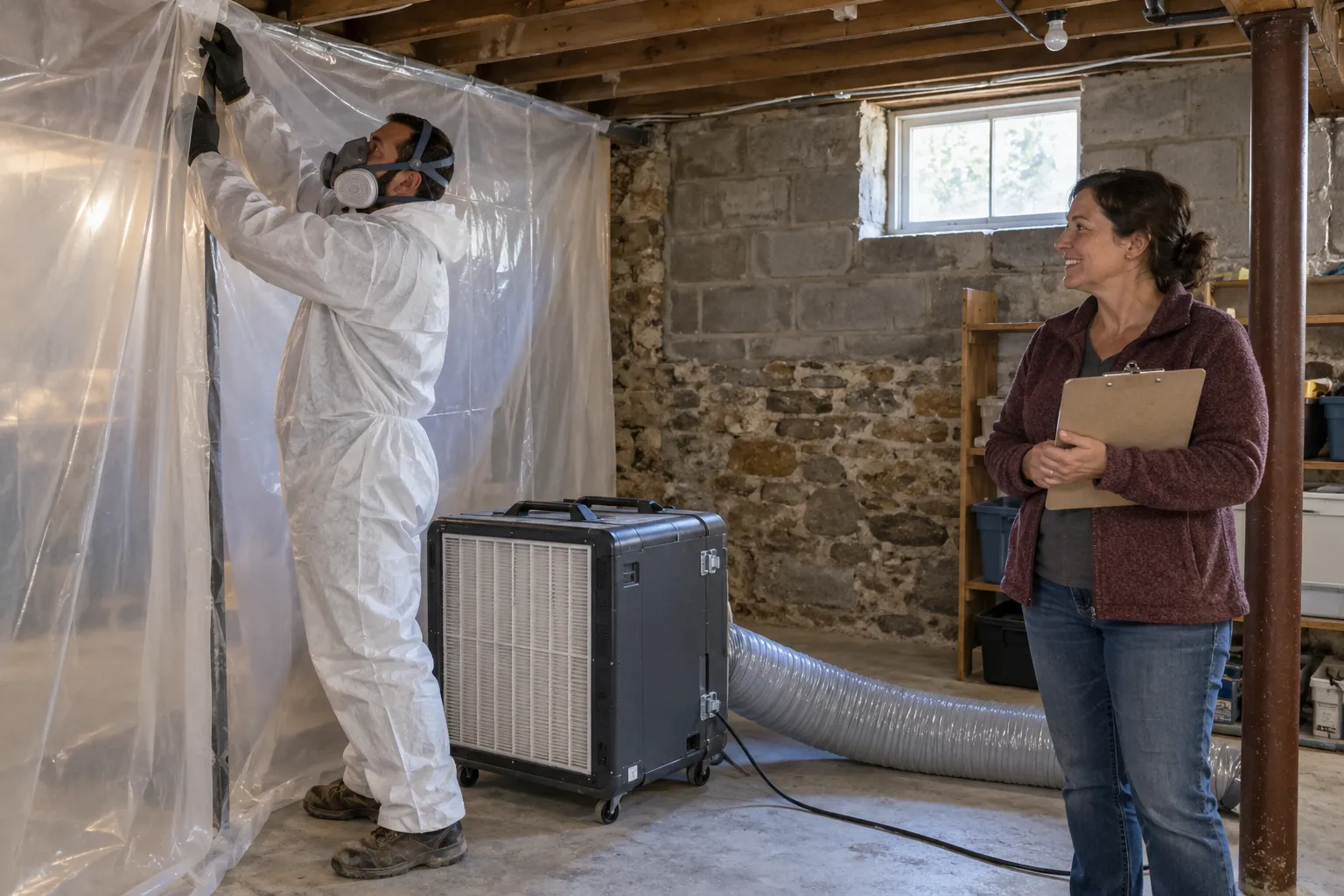
Mold remediation is a controlled cleanup. A provider seals off the affected area, filters the air, removes mold-damaged materials and cleans what can be saved. The last step is the one that counts most: finding and fixing the moisture that let the mold grow.
Episodeopens Mold Help is a referral service. We do not inspect, test or remove mold. You send a request, we route it to an independent provider in our network, and that provider gives you a written quote. Referral, not repair. You compare the scope and price on paper, then decide. Nothing is required of you until you say yes.
You found a dark patch, or you smell something musty. Stop. Do not scrub it dry and do not run a fan over it. That can push spores into other rooms.
Mold remediation means containing the mold, removing it and correcting the moisture that fed it. It is the right search if you want residential mold removal done properly, not just wiped away.
Episodeopens Mold Help is a referral desk. We take your request and route it to an independent local provider. The provider inspects the space, writes the quote and does the work. We do not. Request, match, quote.
Mold needs three things: moisture, a food source and time. Drywall, wood framing, carpet and insulation all count as food.
A small patch can spread behind walls where you cannot see it. Spreading spores settle on new surfaces. Surface sprays rarely solve it, because mold roots into porous material. Waiting often turns a small job into a larger quote.
Any one of these is worth a written quote.
Scope varies by home, but a typical job follows this order:
Ask each provider to list these steps in the quote.
Demolition stirs up spores. Without barriers, they drift into bedrooms, ducts and the kitchen. Containment keeps the mess where it started.
It also protects your daily routine. Many jobs can be sealed to one room or one basement zone, so the rest of the house stays usable.
Removing mold without fixing the water is a temporary win. Cleanup only lasts if the cause is solved.
In cold, snowy regions, common causes include spring snowmelt seeping through basement walls, ice dams, roof leaks and coastal storm flooding. Older homes with full basements and stone or block foundations often stay damp. Poor ventilation in bathrooms and attics adds to it.
Some providers fix the cause themselves. Others tell you which trade to bring in. Either way, get it in writing.
Busy households need a schedule that fits. When you request an estimate, mention work hours, school runs, pets and anyone who is home during the day.
Providers set their own schedules, so ask about timing early. Many can respond quickly, but availability varies. Request a callback to check provider availability if timing is tight.
Some policies may cover sudden damage, such as a burst pipe. Slow leaks and long-term dampness are often treated differently. Check your policy and ask your agent before work begins.
Providers can often help document damage for a claim. Photos, moisture notes and itemized quotes make that easier. We cannot say what your insurer will decide.
Compare quotes, not just totals. Look for:
Be cautious about any quote that is vague or asks for full payment up front.
A good provider walks you through what was done. Many suggest a follow-up check to confirm the work is complete.
Then keep the cause from returning. Run bath fans, keep indoor humidity moderate, clear gutters and direct downspouts away from the foundation. Watch the area for a few weeks and report any musty smell to the provider.
Plastic barriers and filtered air keep spores in the work area and out of living space.
Wet or mold-covered drywall, insulation and carpet are cut out, bagged and carried out.
Surfaces that can stay are vacuumed and wiped to remove settled spores.
The provider identifies the water source and explains how to stop it before rebuilding.
Prices vary with the size of the area, the materials involved and how hard the space is to reach. These are typical U.S. ranges only. Always get a written quote from the provider.
| Job type | Typical range | Notes |
|---|---|---|
| Small area (under 10 sq ft) | $500 – $1,500 | One wall or corner, light containment |
| Single room | $1,500 – $4,000 | Containment and some material removal |
| Basement or several rooms | $4,000 – $10,000 | Larger containment and longer drying |
| Whole-house or severe cases | $10,000 – $30,000 | Heavy removal, often with rebuild work |
| Air filtration equipment | $300 – $1,000 | Often bundled into the main quote |
| Drywall and insulation replacement | $1,000 – $5,000 | Rebuild is sometimes priced separately |
Share your address, what you found and your schedule. The form takes only a few minutes.
Your request is routed to an independent provider in our network that serves your area.
The provider inspects, then sends scope, price and timing. Ask any questions before agreeing.
If you approve, you and the provider set dates that fit your week.
We refer. Independent providers inspect, quote and do the work. You always know who is who.
Each request is routed to a provider who puts scope and price on paper before you decide.
Tell us your schedule. Providers can plan containment and visits around work, school and pets.
Requesting an estimate carries no obligation. Compare, ask questions, then choose.
Send a request and a local mold provider will follow up with next steps. Prefer to talk? Request a callback to check provider availability.
No obligationRemoval suggests taking mold away. Remediation is the full process: containing the area, removing mold and damaged materials, cleaning, drying and fixing the moisture source so the problem does not return.
Bleach may lighten a surface stain, but it rarely reaches mold rooted in drywall or wood. Larger patches are better left to a provider. Do not disturb the area while you request a quote.
Some policies may cover mold that follows sudden damage, such as a burst pipe. Gradual leaks are often treated differently. Check your policy, and ask the provider about documenting damage for a claim.
Send a request and a local mold provider will follow up with next steps. Prefer to talk? Request a callback to check provider availability.
No obligation